


What Should You Do After a Truck Accident in FL?
After a truck accident in Florida, prioritize safety, call 911, and seek medical care immediately. Next, report the crash, gather evidence, take photographs of the accident scene, exchange insurance information, and document your injuries. Also, notify your insurance provider and avoid admitting fault. These steps help protect your health and strengthen your potential truck accident claim.
You should also consult a truck accident lawyer before discussing a settlement with the trucking company’s insurer. At Todd Miner Law, our lawyers can help protect your claim by preserving key evidence, countering insurer tactics, and documenting your damages. We also have local courtroom knowledge, which helps us pursue your case in court if insurers refuse to offer fair compensation. Call 407-894-1480 for a free consultation to discuss your legal options.

What Steps Should You Take After a Truck Accident?
After a truck accident in Florida, your first priority should be safety and medical care. Once you are safe, take steps to document the collision, identify the trucking company, and preserve evidence. The following steps can help protect your health and support a potential personal injury claim:
- Check for injuries: Assess your condition and move away from traffic if it is safe.
- Call 911: Report the collision and request emergency assistance when necessary.
- Seek medical care: Get evaluated promptly, even if your injuries seem minor.
- Identify the truck driver: Obtain the driver’s license, insurance details, and trucking company information.
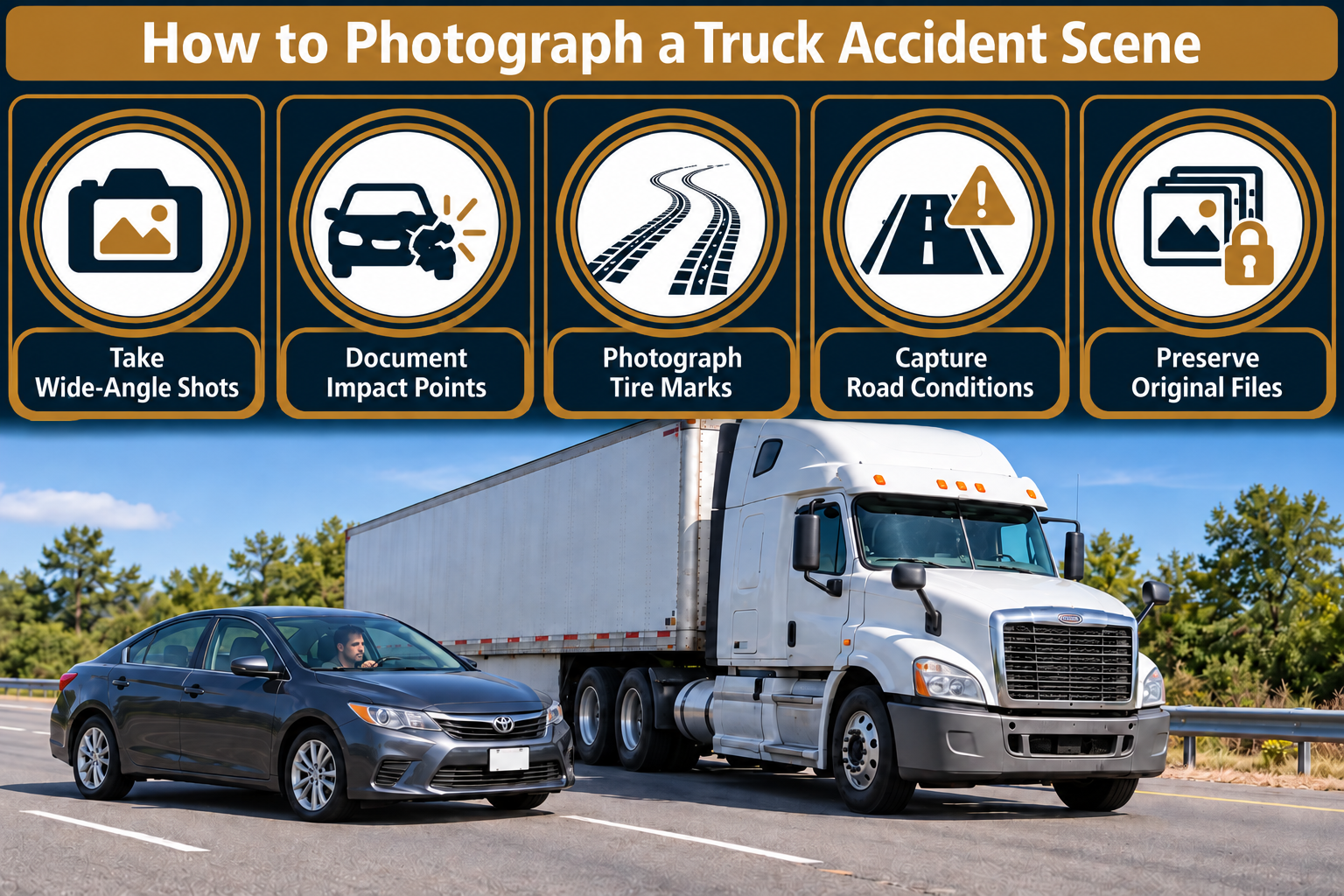
- Photograph the scene: Capture vehicle damage, road conditions, license plates, and truck identification numbers.
- Find witnesses: Collect contact information from people who saw the collision.
- Notify your insurer: Report the accident accurately and follow your policy’s notification requirements.
- Keep important records: Save medical bills, repair estimates, photographs, and proof of missed work.
- Consult a Lawyer: Contact our truck accident lawyers to discuss your rights and preserve important trucking evidence.
- Avoid premature settlements: Review your injuries, financial losses, and legal options before accepting compensation.
- Write down your recollection: Record everything you remember about the collision, including the truck’s movements and events leading up to the impact.
- Check your police report for errors: Review it for incorrect details about the vehicles, drivers, or crash location, and request corrections where appropriate.
- Keep your damaged vehicle intact: Avoid selling, scrapping, or making major repairs before investigators can examine it.
- Preserve damaged personal belongings: Keep clothing, child car seats, or other items damaged in the collision because they may support your claim.
- Identify the truck’s trailer number: Record the trailer’s identification number if available, especially when the tractor and trailer belong to different companies.
- Keep a record of missed commitments: Note important appointments, business activities, or other obligations you missed because of the accident.
- Confirm your insurer’s payment arrangements: Ask whether the insurance carrier pays service providers directly or expects you to cover costs and seek reimbursement.
How Can You Identify the Trucking Company and Trailer After an Accident?
To identify the trucking company after an accident, check the commercial truck’s identifying markings, license plates, and USDOT number. These details can help establish which motor carrier operated the truck and identify other companies potentially involved in the collision.
Here’s how you can look for this information:
- Trucking company name: Check the cab doors for the motor carrier’s legal name or registered business name.
- USDOT number: Look for the USDOT number displayed on the truck, usually near the company name. You can use the FMCSA SAFER database to look up the registered motor carrier.
- Tractor identification: Photograph the truck’s license plate and unit number. Record its vehicle identification number (VIN) if safely accessible.
- Trailer identification: Record the trailer’s license plate, unit number, and any company markings. The trailer may belong to a different business than the truck’s operator.
If you cannot collect these details at the scene, review the police report or ask your truck accident lawyer to investigate. Identifying the motor carrier, tractor owner, and trailer owner can help determine which parties may bear responsibility for the collision.
Should You Call the Police After a Truck Accident?
Yes, you should call the police immediately after a truck accident in Florida, even if no one appears injured. Police officers can secure the scene, identify witnesses, document vehicle damage, and prepare an official crash report. This report provides important details that may help establish liability and support your insurance claim.
Under Florida law, two reporting requirements are particularly relevant:
- Florida Statutes § 316.065: You must immediately notify law enforcement if the accident causes injuries, death, or at least $2,000 in apparent property damage.
- Florida Statutes § 316.066: An officer who investigates a crash involving a commercial motor vehicle must complete a long-form crash report.
When officers arrive, explain what happened without guessing about fault. Additionally, obtain the investigating officer’s name and report reference number so you can request a copy later.
How Do You Get a Truck Accident Report in Florida?
You can obtain a truck accident report through the Florida Crash Portal or the law enforcement agency that investigated the crash. You’ll need the accident date, location, and report or case number, if available. Florida charges $10 per report, plus a $2 online convenience fee per transaction.
To request your report online, follow these steps:
- Visit the Florida Crash Portal and select the crash report purchasing option.
- Enter the required crash details to locate your report.
- Verify your eligibility and provide any required identification or information.
- Pay the applicable fee and download your report within 48 hours of purchase.
Under Florida Statutes § 316.066, crash reports containing personal information remain confidential for 60 days after filing. However, drivers involved in the accident and their attorneys can access them during this period.
Why Should You Seek Medical Attention Immediately?
You should seek medical attention immediately after a truck accident to create medical records that connect your injuries to the crash. This helps prevent disputes over injury causation. Additionally, Florida’s personal injury protection (PIP) coverage requires medical treatment within 14 days to qualify for benefits.
Furthermore, truck accidents can cause internal bleeding, concussions, and spinal injuries without obvious symptoms. In such cases, adrenaline released during the crash can temporarily mask pain, sometimes for several hours. In fact, some injuries may take hours or days to produce noticeable symptoms. Therefore, early medical evaluation helps doctors identify hidden injuries and begin appropriate treatment.
What Should You Tell the Insurance Company?
After a truck accident, inform your insurance company about the crash date, location, parties involved, and police response. Also, provide details about the damage to your vehicle and any medical care you’ve received. However, avoid making assumptions about fault, estimating unknown details, or downplaying injuries before doctors complete their evaluation.
Here are some other things you should keep in mind when speaking with insurance adjusters:
- Keep your answers brief: Answer only what the adjuster asks without volunteering unnecessary details about the crash.
- Avoid admitting fault: Even casual statements suggesting responsibility could affect how the insurer evaluates liability.
- Don’t speculate about injuries: Describe your current symptoms without predicting your recovery or minimizing your condition.
- Ask for clarification: If you don’t understand a question, ask the adjuster to explain it rather than guessing.
- Don’t agree to a settlement verbally: Avoid accepting an offer before understanding your medical expenses, lost income, and other damages.
Should You Move Your Vehicle After a Truck Crash?
Yes, you should move your vehicle after a truck crash in Florida if you can do so safely and no one has been injured. Under Florida Statutes § 316.061, drivers must make reasonable efforts to clear vehicles blocking traffic after property-damage-only crashes. However, if someone suffered injuries, call 911 and follow police instructions.
Furthermore, you should take photos of the vehicles’ original positions and visible damage before moving, if conditions allow. If your vehicle cannot move safely, turn on your hazard lights and avoid standing near moving traffic. Also, never attempt to push a damaged vehicle into traffic. Instead, wait in a safe location and let emergency responders handle the situation.
Situations where you should not move your vehicle after a truck crash include:
- Suspected fuel leaks: You notice leaking fuel, smoke, or sparks that could indicate a fire hazard.
- Unstable cargo: The truck has spilled hazardous materials or carries a load that could shift or fall.
- Severe vehicle damage: The crash damaged your vehicle’s wheels, steering, or suspension, making it unsafe to operate.
- Downed power lines: Electrical wires have fallen onto or near your vehicle, creating a risk of electrocution.
- Unsafe road conditions: Floodwater, poor visibility, or unstable ground make moving the vehicle dangerous.
Which Records You Should Keep After a Truck Accident?
You should keep your police report, medical records, treatment bills, insurance documents, and proof of lost wages. It is also important to save all communication with insurance companies to prevent disputes over your statements.
Here are some other important records you should preserve:
- Photographs and videos: Images of vehicle damage, visible injuries, road conditions, and the accident scene.
- Witness information: Names, phone numbers, contact details, and written statements from people who witnessed the crash.
- Repair estimates and receipts: Documents showing vehicle repair costs, towing charges, and other property damage expenses.
- Employment records: Pay stubs, attendance records, and employer letters showing missed work and lost income.
- Out-of-pocket expense receipts: Proof of transportation costs, prescription expenses, and other accident-related payments.
- Personal injury journal: Daily notes describing your pain, physical limitations, recovery progress, and how your injuries affect everyday activities.
How Do You Track Expenses After a Truck Accident?
To track expenses after a truck accident, create a spreadsheet or expense log where you record every accident-related financial loss. For each entry, note the date, amount, purpose, and payment status. Also, save supporting receipts and invoices in organized folders. This helps you maintain accurate records throughout your claim.
You can also follow these steps to organize your expenses:
- Update your log regularly: Enter expenses as they occur rather than relying on memory weeks later.
- Organize receipts: Create separate digital folders for medical payments, vehicle repairs, and other accident-related costs.
- Track payment sources: Record whether you, your insurance provider, or another party covered each expense.
- Check for missing expenses: Review bank statements, credit card transactions, and insurance statements against your log.
- Maintain backups: Store digital copies of your records to prevent the loss of important financial documents.
When Is the Right Time to Contact a Truck Accident Lawyer?
You should contact a truck accident lawyer as soon as possible after receiving necessary medical care. Early legal assistance helps preserve critical evidence, identify potentially liable parties, and protect you during insurance investigations. This is especially important because trucking companies may begin investigating immediately, while electronic records and other evidence can disappear.
You should particularly consider contacting an attorney when:
- You suffered serious injuries: Your claim may involve extensive medical expenses, lost wages, and future treatment costs.
- Multiple parties may share liability: Identifying the responsible trucking company, driver, or maintenance contractor may require a detailed investigation.
- The insurer disputes fault: Your lawyer can examine available evidence and challenge unsupported liability findings.
- The trucking company’s insurance adjuster contacts you: Early legal guidance can help you avoid statements or agreements that may affect your claim.
- You receive a settlement offer: An attorney can assess whether the proposed amount reflects your documented losses and potential future expenses.
How Can You Preserve Truck Accident Evidence?
To preserve truck accident evidence, consult our lawyers at Todd Miner Law as soon as possible. Trucking companies control important records that you may not access independently. Our attorneys can use the following legal tools to obtain and protect key evidence before it disappears or becomes unavailable:
- Preservation letters: We formally notify trucking companies to preserve driver logs, black box data, maintenance records, inspection records, and other relevant evidence.
- Discovery requests: After filing a lawsuit, we request electronic records, internal communications, inspection reports, and other documents relevant to the crash.
- Subpoenas: We use subpoenas during litigation to obtain relevant records or testimony from third parties, including maintenance contractors and surveillance camera operators.
- Depositions: We question truck drivers, company representatives, and other witnesses under oath to obtain information about the accident.
- Court orders: If a party refuses to provide legally discoverable evidence, we can ask the court to compel production or protect relevant evidence from destruction.
What If You Left the Scene Without Collecting Evidence?
Leaving the truck accident scene without collecting evidence does not automatically prevent you from filing a claim. You can still obtain important details from police reports, witness statements, GPS data, vehicle damage, traffic camera footage, and insurance investigations. However, some evidence may disappear quickly, making it important to act promptly.
If you have little or no evidence, our lawyers at Todd Miner Law can help investigate what happened. We can identify potential sources of evidence, request available footage, locate witnesses, and take legal steps to preserve trucking records. If necessary, we can also revisit the accident scene to look for remaining evidence, such as skid marks, road debris, or damaged traffic signs.
These findings may help reconstruct how the crash happened, establish fault, and support your claim even without photographs from the scene. Call us at 407-894-1480 for a free consultation to discuss your truck accident case and available legal options.
How Do You File a Truck Accident Claim?
To file a truck accident claim in Florida, notify your insurance provider and gather evidence to establish liability and document your losses. Next, identify the responsible parties and submit your claim with supporting documents. You can also consult a truck accident lawyer to handle communications with the insurer and protect your interests.
Once you submit your claim, the insurance company begins reviewing the accident and your damages. Under Florida Administrative Code Rule 69O-166.024, insurers generally must acknowledge claim communications within 14 calendar days, although exceptions apply. However, this deadline does not require them to approve or settle your claim.
A lawyer tracks applicable deadlines, responds to information requests, and monitors the investigation. After reviewing the evidence, the insurer may accept liability, dispute your claim, or offer a settlement. An attorney then negotiates for a fair settlement or files a truck accident lawsuit if necessary.
How Long Do You Have to Take Legal Action in Florida?
Under Florida Statutes § 95.11, you generally have two years from the truck accident date to file a truck accident lawsuit based on negligence. Florida law also allows two years to file a wrongful death lawsuit, typically starting from the date of death. However, certain exceptions may affect these deadlines.
Importantly, negotiating with insurance companies does not automatically extend the filing deadline. If you miss it, you may lose your right to pursue compensation through a lawsuit. Therefore, consult a truck accident attorney early to determine your applicable deadline and preserve evidence before it disappears.
What Mistakes Should You Avoid After a Truck Accident?
After a truck accident in Florida, avoid delaying medical care, admitting fault, discussing the crash on social media, or accepting an early settlement. Also, never give insurance adjusters inaccurate information or discard important evidence. These mistakes can create legal complications, weaken your claim, and reduce your chances of recovering fair compensation.
Other common mistakes truck accident victims should avoid include:
- Failing to report the crash: Without a police report, establishing what happened and supporting your version of events can become difficult.
- Ignoring follow-up treatment: Gaps in medical records may lead insurance companies to question your injuries and dispute your compensation claim.
- Giving a recorded statement without preparation: Inaccurate or speculative statements may create inconsistencies that insurance adjusters can use against your claim.
- Overlooking future expenses: Ignoring future medical costs and lost income may leave you with a settlement that doesn’t cover your long-term losses.
- Accepting the first settlement offer: An early settlement may undervalue your losses and prevent you from seeking additional compensation later.
- Hiring a general attorney: An attorney without truck accident experience may overlook federal trucking regulations, crucial evidence, or potential sources of compensation.
- Assuming only the truck driver is responsible: Ignoring the trucking company, cargo loader, or maintenance contractor may leave potentially liable parties out of your claim.
Call Our Lawyers for a Free Consultation After a Truck Accident in Florida!
A truck accident can be stressful on its own. However, the challenges often continue long after the crash. You may face mounting medical bills, missed work, insurance calls, and liability disputes. Managing all this while recovering from serious injuries can quickly become overwhelming.
In such situations, our lawyers at Todd Miner Law can handle the legal aspects of your case while you focus on recovery. We have over 33 years of experience handling truck accident cases across Florida. We also offer free virtual consultations if you cannot visit our office. Plus, you pay no attorney’s fees unless we recover compensation for you. Call 407-894-1480 for a free consultation, or visit us at 915 Outer Road, Orlando, FL 32814, to discuss your truck accident claim.
FAQs
What If You Cannot Identify the Trucking Company?
If you cannot identify the trucking company after a crash, check the truck’s USDOT number, license plate, and identifying markings. You can also review the police report or search federal trucking records. Additionally, a truck accident lawyer can investigate ownership, employment, and insurance information to identify potentially responsible parties.
Can You Repair Your Car Before the Truck Claim Ends?
Yes, you can repair your car before your truck accident claim ends, but first allow the insurers to inspect the damage. Also take detailed photos, obtain repair estimates, and keep all receipts. You should also ask your lawyer whether repairs could destroy important crash evidence. Otherwise, you risk disputes over vehicle damage and compensation.
What Information Should You Exchange With the Truck Driver?
After a truck accident, exchange your name, address, phone number, driver’s license number, vehicle registration details, and insurance information with the truck driver. Also, request the trucking company’s name, address, and contact number. In addition, obtain the truck’s license plate and USDOT number to help identify the responsible motor carrier.
Should You Sign Insurance Forms After a Truck Crash?
No, you should not sign insurance forms after a truck crash without reviewing their terms and understanding your rights. While routine claim forms may be necessary, settlement agreements and medical authorizations can affect your claim. Therefore, consult a truck accident lawyer before signing documents from the trucking company’s insurance adjuster.
What If You Cannot Remember How the Crash Happened?
If you cannot remember how the truck crash happened, avoid guessing or making assumptions about fault. Instead, tell the police and insurance adjusters only what you remember. Also, seek medical attention because memory gaps can indicate a concussion or other head injury. Meanwhile, your attorney can review the police report, witness statements, dashcam footage, and truck records to reconstruct what happened.
How Do You Stay Safe at the Accident Scene?
To stay safe after a truck accident, remain alert to approaching vehicles and avoid standing between damaged vehicles or near the truck’s blind spots. Keep a safe distance from spilled cargo, broken glass, and unstable trailers. You must also avoid walking across traffic lanes and follow emergency responders’ instructions to prevent further injuries.
