


Can Your Lawyer Reduce Medical Bills After a Settlement?
Yes, your lawyer may negotiate the medical balances that must be paid from your settlement. They can review provider charges, verify valid liens and reimbursement claims, dispute unsupported amounts, and request reduced payoffs. Any reduction can increase the portion of the settlement that you ultimately receive.
At Todd Miner Law, we review each outstanding balance before settlement funds are distributed. We verify the amount each provider or lienholder is claiming, identify charges that may be disputed, and seek a lower payoff where appropriate. If you are dealing with medical liens after a car accident, call 407-894-1480 for a free case evaluation with our experienced personal injury attorneys.
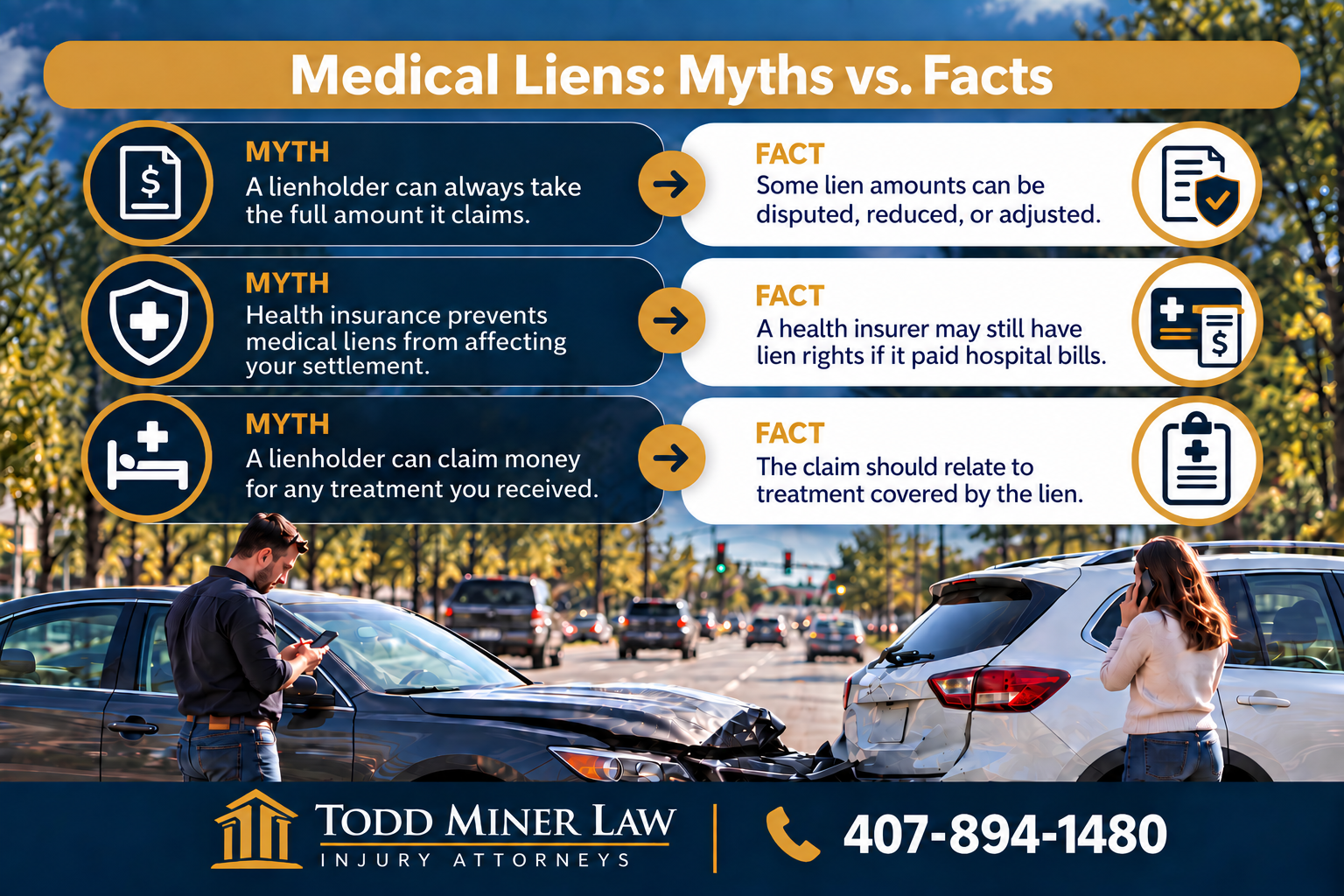
How Can Your Lawyer Reduce Medical Bills After a Settlement?
At Todd Miner Law, our lawyers reduce accident-related medical bills after settlement by reviewing each balance, identifying negotiable charges, and contacting providers or lienholders directly. We challenge billing errors, dispute unfair charges, request reduced amounts, and use the available settlement funds during negotiations with each creditor.
Here are some strategies we use during negotiations:
1. Review Itemized Medical Bills
Our lawyers request itemized bills from hospitals, doctors, therapists, imaging centers, and other providers. We then compare those charges with your medical records and treatment dates.
That review can reveal:
- Duplicate charges
- Charges for treatment you did not receive
- Incorrect procedure codes
- Payments that were never credited
- Charges unrelated to the accident
- Inflated facility or service fees
We dispute those amounts before paying any amount from your total settlement.
2. Offer Immediate Payment
Providers sometimes prefer a guaranteed payment now instead of spending months pursuing the full balance. We can use the settlement funds to make a specific lump-sum offer. For example, rather than automatically paying a $15,000 balance, we may propose a lower amount as full satisfaction of the bill. The provider may accept, reject, or counter that settlement offer.
3. Verify Insurance Payments and Credits
We compare the provider’s balance with payments from health insurance coverage, PIP, Medicare, Medicaid, or any other source that covered your treatment. Then, we check whether the provider properly credited those payments and applied any required adjustments. If a bill still includes amounts already paid, we challenge the balance before negotiating anything further.
4. Use Limited Recovery as Leverage
If the settlement does not fully cover your medical expenses, attorney fees, case costs, and other obligations, we explain the financial limitations to providers and lienholders. We provide a breakdown of the settlement and the amounts that must be paid from it. This shows why paying the full medical balance would place an unfair burden on you.
5. Counter the Provider’s Initial Offer
Negotiations may involve several rounds rather than a single request for a discount. If a provider rejects our initial offer or proposes a reduction that is too small, our lawyers can respond with a counteroffer. We continue negotiating based on the available settlement, the outstanding balance, and the circumstances of your case until we reach an acceptable resolution.
How Does the Common Fund Doctrine Affect Medical Liens?
In Florida, the common fund doctrine may reduce how much a lienholder can take from your settlement. Since your lawyer did the work and paid the costs needed to recover that money, the lienholder may have to share part of those legal expenses.
For example, if a lienholder claims $10,000 from your settlement, that amount may be reduced to reflect its share of attorney fees and case costs. However, this rule does not apply to every medical lien. It depends on the type of lien, the contract involved, and any applicable law governing repayment.
Who Can Claim a Medical Lien Against Your Payout?
Medical liens can come from parties that paid for your accident-related treatment or agreed to wait for payment until your personal injury case is settled. This may include healthcare providers such as hospitals and doctors, health insurance companies, Medicare, Medicaid, and workers’ compensation carriers.
Some other parties that may claim part of your settlement include:
- Ambulance providers for unpaid emergency transport bills.
- Physical therapy providers for rehabilitation and therapy expenses.
- Providers under a letter of protection for the treatment they agreed to provide before receiving payment.
What Is a Letter of Protection?
A letter of protection, often called an LOP, is an agreement that allows you to receive medical treatment now and pay the provider later. Instead of requiring payment up front, the provider agrees to wait until your case is resolved before collecting payment.
LOPs are common when an injured person does not have enough insurance coverage or cannot afford ongoing treatment after an accident. They can help you continue care while your personal injury claim is pending.
However, the medical charges still become part of your case. Once the settlement is reached, the provider may claim payment for the medical costs from the payout in accordance with the settlement agreement.
What Payment Plans Are Accepted by Medical Lienholders?
Medical lienholders may accept a reduced lump-sum payoff, monthly installments, partial payment followed by installments, or a pro rata reduction. Some providers may also agree to deferred payment terms, depending on the lien amount, settlement size, and the provider’s own payment policies.
Here is how these arrangements work:
- Reduced Lump-Sum Payoff: A provider may agree to accept less than the full lien amount if it receives a single immediate payment from the settlement.
- Partial Payment Plus Installments: Some lienholders may accept part of the balance from the settlement and allow the remaining amount to be paid over time.
- Monthly Payment Plan: A provider may divide the remaining balance into monthly payments after receiving an initial amount from the settlement.
- Pro Rata Reduction: When several lienholders are seeking payment from the same limited settlement, each may agree to accept a reduced percentage of its balance.
- Deferred Payment: Some providers may agree to delay collection for a set period rather than demand immediate payment.
Your lawyer can discuss these options with the lienholder and confirm the final arrangement in writing before settlement funds are distributed.
Can Medicaid Claims Be Reduced in Florida?
Yes, a Medicaid claim can sometimes be reduced after a Florida personal injury settlement. However, Medicaid has strong repayment rights under Florida law. According to Florida Statute § 409.910(11)(f), Medicaid generally receives one-half of the remaining recovery after attorney’s fees and taxable costs.
However, Medicaid cannot recover more than the amount it actually paid for your medical care. In some cases, the statutory formula may overstate the medical portion of your recovery. Your lawyer can then request an administrative hearing to challenge that amount.
During the administrative hearing, your lawyer must show why Medicaid should receive less than the amount calculated under the statutory formula. They may rely on medical records, billing statements, settlement documents, and evidence of other damages. However, you have to pay your own attorney’s fees and costs for the administrative proceeding.
How Long Does Medical Bill Negotiation Take?
Medical bill negotiation often takes about 2 to 6 weeks after settlement for straightforward provider balances. However, cases involving several providers, disputed charges, health insurance reimbursement claims, or Medicare and Medicaid liens may take one to three months or longer.
The timeline usually depends on the following factors:
- Number of parties involved: Negotiating with one provider usually takes less time than resolving bills from several hospitals, specialists, therapists, and imaging centers.
- Billing accuracy: If the provider’s balance includes errors, duplicate charges, or missing insurance credits, your lawyer may need updated statements before negotiations begin.
- Lien verification: A provider or insurer may need to confirm the lien amount and provide supporting records before your lawyer can negotiate it.
- Provider response time: Some billing departments respond within days, while others may take longer to review a reduction request or issue a counteroffer.
What Happens if Medical Expenses Exceed Your Settlement?
If your medical expenses exceed your settlement, you may remain responsible for the unpaid balance after the available settlement funds are used. In that situation, a hospital or doctor may continue collection efforts until the remaining amount is resolved.
Those collection efforts may include:
- Sending additional billing notices
- Adding late fees where allowed
- Referring the balance to a collection agency
- Contacting you to arrange repayment
- Offering a payment plan for the remaining balance
However, if you have access to other benefits, they may help cover part of the remaining medical balance. For example, in an auto accident case, underinsured motorist coverage may provide additional compensation when the at-fault driver’s liability coverage is not enough to cover your damages.
In addition, some nonprofit or public hospitals offer financial assistance or charity-care programs. If you meet the eligibility requirements, these programs may reduce or waive part of the unpaid hospital balance.

Who Pays Your Medical Bills if You Lose Your Personal Injury Case?
If you lose your personal injury case, you remain responsible for any medical bills that have not been paid by another source. However, if health insurance, PIP, or Med Pay already covered part of your treatment, you generally do not repay those benefits simply because you lost the case.
These insurers may have reimbursement rights when you recover money through a settlement or judgment. If you recover nothing, there are no settlement funds for them to claim against. However, you may still owe deductibles, co-pays, uncovered charges, or unpaid provider balances.
Call Todd Miner Law to Resolve Medical Liens After a Car Accident!
After a car accident, a lienholder may take payment directly from your settlement, leaving you with far less money than expected. If several liens exist, those deductions can add up quickly and reduce the compensation left for your lost income, ongoing care, and other expenses.
At Todd Miner Law, our legal assistance does not stop once we recover compensation for your accident-related damages. We also address medical liens and reimbursement claims that can reduce your final payout. Our client-focused approach has earned us Orlando Weekly’s Best of Orlando recognition for four consecutive years, from 2023 through 2026. Call 407-894-1480 or visit our Orlando office at 915 Outer Rd, Orlando, FL 32814 for a free consultation.
FAQs
Can a Lawyer Negotiate Hospital Bills From Out-of-Network Providers?
Yes, a lawyer may negotiate directly with an out-of-network provider to reduce the unpaid balance after settlement. Since these providers are not limited by your health insurer’s contracted rates, they may leave higher unpaid balances. Negotiation can help lower that balance before it is deducted from your settlement.
Can a Provider Send You to Collections After Settlement?
Yes, if a medical provider still has an unpaid balance after your case settles, it may send that debt to a collection agency. Once that happens, you may face collection calls or other collection efforts. Resolving outstanding medical balances before settlement funds are distributed can help prevent that problem.
What Happens if a Provider Does Not Sign a Lien Release?
If a provider does not sign a lien release after payment or settlement, the lien may remain formally unresolved. As a result, the provider could still claim an interest in the settlement funds. Therefore, it is important to consult an experienced attorney who can confirm payment, obtain written proof, and resolve the lien before final distribution.
What Is the Difference Between a Medical Bill and a Medical Lien?
A medical bill is the amount a healthcare provider charges for the treatment you received. In contrast, a medical lien is a legal claim against your settlement or judgment for unpaid medical costs. Not every unpaid bill becomes a lien, and the lienholder must have a valid legal or contractual basis to claim settlement funds.
How Much Can a Lawyer Reduce Medical Bills After a Settlement?
There is no standard percentage that a lawyer can reduce medical bills after settlement. The amount depends on the provider, lien balance, billing issues, available settlement funds, and other claims against the recovery. Some reductions may be limited, while others can significantly lower the amount that must be paid from your settlement.
